Quick Summary
Event trip planning starts by locking the event date, start time and venue address, then building lodging, transport and nearby experiences around that anchor. Local expertise helps fill the gaps with restaurants, neighborhoods and backup options that a standard map search misses.
- Confirm event date, start time, doors-open time and venue address first.
- Choose lodging by travel time to the venue rather than by star rating.
- Plan one anchor experience per day and leave flexible space between plans.
- Leave at least an hour between your plans and any reservation you cannot move.
- Pre-book parking and save its address offline, since surface lots often sell out.
Table of Contents
- Why Local Expertise Makes Event Trip Planning Simpler
- Step 1: Define Your Trip Goals and Travel Style
- Step 2: Build Your Event Trip Planning Checklist
- Step 3: Choose Attractions Near Event Venues
- Step 4: Map Out a Kansas City Event Itinerary
- Step 5: Plan Transportation, Reservations and Event-Day Logistics
- Booking Your Event Trip With Confidence
- Frequently Asked Questions
How to Plan an Event Trip With Local Expertise
Last Updated: October 28, 2026
Why Local Expertise Makes Event Trip Planning Simpler
Event travel is becoming one of the first decisions travelers make, and it is a harder one to plan than a regular vacation. According to World Economic Forum Travel & Tourism Development Index 2026, global performance trends, travel and tourism development improved in 14 of 17 pillars between 2024 and 2026.
This is where local expertise earns its keep. At Kansas City, our editors provide locally grounded visitor guidance and curated recommendations for attractions, neighborhoods and hotels.
Simplified planning does not mean fewer choices. Research from Forbes analysis on experiences and events as the first travel decision argues that experiences and events are becoming the first travel decision, ahead of flights.
Step 1: Define Your Trip Goals and Travel Style
Start by deciding what the trip is for. An event trip planned around a single game, concert or festival looks very different from a long weekend built around food and music.
Next, match your travel style to the schedule. Some visitors want every hour planned; others want a loose structure with room for spontaneous stops.
Finally, note constraints early: dietary restrictions, mobility needs, children traveling with you, or a tight budget.
Step 2: Build Your Event Trip Planning Checklist
A working checklist keeps event trip planning from turning into a scramble. Use it as a single reference for dates, lodging, transport and backup options.
Review the checklist a week before departure and again the day before. For a step-by-step format with timing and packing tips, see planning a family museum day downtown. Minor items, a missing confirmation email or an unlisted parking option, cause the most stress on event day.
Step 3: Choose Attractions Near Event Venues
Proximity matters for leisure travel. Time spent crossing a city before a show is time you cannot get back.
Short stops, a coffee shop, a local market, a quick museum visit, fit between arrival and your plans.
The best local picks often skip the tourist-facing version of a place. Our guide to spotting overpriced attractions and finding authentic local spots explains how to tell the difference.
Balancing Event Time With Local Experiences
Plan one anchor experience per day rather than three, and leave at least an hour between your plans and any reservation you cannot move, because crowds and traffic can run longer than expected.
Keep non-event time flexible. A relaxed lunch with no fixed end time usually beats a packed schedule that forces you to rush.
Step 4: Map Out a Kansas City Event Itinerary
Most itinerary advice organizes a trip by day and time slot. A trip can use a different spine: organize around your main plans, then build outward. That single change turns a list of activities into a workflow.
The event-anchored itinerary method
- Lock the event. Confirm date, start time, doors-open time and venue address. Everything else is built around this block.
- Set travel dates around the event, not the other way around. Arrive at least one night before if the event is the reason for the trip, so a delayed flight cannot cost you the ticket. Depart the morning after, not the same night, unless the event ends early.
- Choose lodging by travel time to the venue, not by star rating. A short walk or one transit line beats a nicer room across town on event night.
- Place transport anchors. Arrival transfer, event-day arrival mode, event-day return mode, departure transfer.
- Fill the gaps with nearby experiences. Morning and afternoon slots get attractions within a short radius of the venue or lodging; the day after gets the longer experiences.
- Add a buffer day or a buffer block. One unscheduled half-day absorbs delays, fatigue and the spontaneous local recommendation that turns out to be the best part of the trip.
A three-day event trip, built around the event window
| Day | Morning | Afternoon | Evening | Fixed vs. flexible |
|---|---|---|---|---|
| Arrival | Travel and check in near the venue | Walk the surrounding district to learn the streets | Casual dinner near lodging, early night | Flexible except check-in |
| Event day | Light breakfast; confirm tickets, transit and weather | Pre-event meal with a hard end time; transit to venue | Event; post-event meal or walk back | Event and pre-event meal fixed; everything else flexible |
| Departure | Slow breakfast; final local stop | Departure transfer | , | Departure transfer fixed |
Mark every row as fixed or flexible before you book anything. Fixed items are reservations and transfers. Flexible items are the ones you can move without losing money. When the two conflict, the fixed item wins.
Build each day around one anchor
Plan one anchor experience per day, a longer local experience on the buffer day, and let the rest flex. Leave at least an hour between your plans and any reservation you cannot move, because crowds and traffic can run long.
A useful rule: if a day has more than one fixed time commitment, you have probably overbooked it. To choose which smokehouse fits your plans, read the regional barbecue styles explained.
Layer in local expertise at the gap points
- The pre-event meal. A local contact knows which nearby restaurants can seat and serve you inside a 90-minute window on a busy night, and which ones will make you late.
- The post-event wind-down. Locals know which spots stay open late and are a short walk from the venue, and which ones look close on a map but require a long detour. To check whether a barbecue spot is still serving, use this practical guide to late-night barbecue.
- The buffer day. This is where a local recommendation beats a review site, a neighborhood market, a live music set, a food stall that draws regulars rather than tourists.
- The contingency. A local contact can suggest a second route, a second restaurant or a second activity when the first plan falls through.
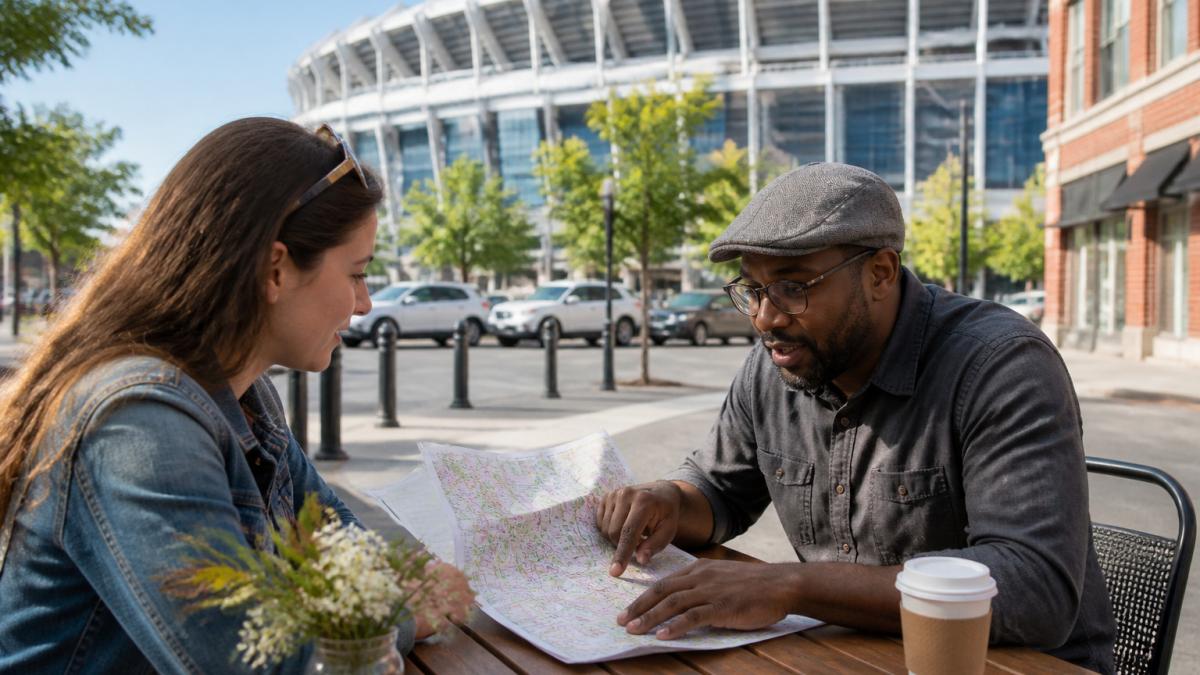
!A visitor and a local guide reviewing a printed itinerary map together at a sidewalk cafe in a Midwestern city, with a stadium-district street visible behind them
Step 5: Plan Transportation, Reservations and Event-Day Logistics
Plan the whole loop, arrival, entry, exit and return, before you leave your lodging.
Choose your mode before you choose your route
- Walking works when lodging is within about a mile of the venue and the route stays on lit, populated streets after the event. It is the most predictable option on event night because it is immune to rideshare surges and transit queues.
- Fixed-route transit (bus or rail) is efficient before an event and slow after one, because everyone leaves at once. Check the last-service time for your return leg; many systems run reduced late-night schedules on weekends and holidays.
- Rideshare and taxis are reliable on arrival and unreliable on departure. Expect long pickup waits and higher fares in the 30-60 minutes after a major event ends. Walk several blocks away from the venue footprint before requesting a ride; pickup zones directly outside gates are often closed or gridlocked.
- Driving only makes sense if you have confirmed parking in advance. Pre-book a garage or lot and save the address offline. Surface lots near venues frequently sell out or convert to permit-only on event days.
Sequence your reservations around the event window
- Event ticket and entry time (fixed).
- Transit or parking reservation for arrival (semi-fixed; book once you know the entry time).
- Pre-event meal with a hard end time at least 90 minutes before gates open, so a slow kitchen does not cost you the opening act.
- Post-event meal with a flexible start time, or a backup that stays open late. Many restaurants stop seating before their posted closing time, so confirm the last seating, not the closing hour.
- Return transport, either a pre-booked ride with a buffer or a walking route you have already traced.
Keep a backup for every reservation you cannot move. A second restaurant within walking distance, a second parking garage, and a second transit line turn a cancellation into a detour instead of a crisis.
Manage the crowd, not just the calendar
- Arrive early for security. Large venues open gates well before start time, and security lines peak in the 30 minutes before the event. Aim to be through the gate, not in line, by that peak.
- Know your entry gate. Stadiums and arenas often assign or recommend specific gates by ticket section. Entering the wrong side can add a full lap around the building.
- Set a meeting point. Pick a specific, recognizable landmark outside the venue, a particular statue, storefront or transit entrance, and agree on it before you separate. Cell service often degrades in dense crowds, so a physical meeting point beats a phone call.
- Plan a contingency route. Identify a second way out of the venue district, a side street, a different transit station, a secondary pickup zone, in case the main exit is closed or overwhelmed.
Build a weather and disruption buffer
Check the forecast before you travel. Pack a layer, a rain shell and comfortable walking shoes, because the walk from transit or parking may be outdoors.
Finally, save every confirmation, parking, reservation, transit pass, in one offline-accessible folder.
Booking Your Event Trip With Confidence
Careful planning can help shape a trip. Confirm current details such as hours directly with each venue or provider before you go.
Kansas City offers locally grounded visitor guidance and curated recommendations for attractions, neighborhoods and hotels.
Frequently Asked Questions
How do you plan a trip around an event?
Start with your travel dates, arrival and departure times, and how long you need to get from your lodging to your destinations. Block those times first, then fill the open hours with dining, neighborhoods and attractions. Build in a buffer between plans. Visitor resources can help you check which nearby options stay open on the days you are visiting.
What should you include in an event travel itinerary?
A useful itinerary lists each day with your plans, transportation, meal stops, and one or two activities. Include confirmation numbers for reservations, the address of your lodging, and a backup option for each outdoor activity in case of weather. Keep the itinerary on your phone and a printed copy.
How far in advance should you plan an event trip?
Plan as early as you can. Begin with your destination and dates, then research transportation and restaurant options. If you are visiting for a short stay, start your research early so you have time to compare options. Check official websites for current arrival and parking guidance.
How can local expertise make trip planning easier?
Local expertise can help with trip planning in unfamiliar neighborhoods. Pairing locally grounded visitor guidance with a simple planning checklist can help organize your research.
How do you choose attractions near an event venue?
Look for attractions within a short travel radius of your destination that fit your schedule and interests. Prioritize options that are open during your visit window. Mix one or two high-energy stops with quieter neighborhoods. Verify hours and reservation requirements directly with each attraction before you go.
What should you consider when planning transportation for an event trip?
Compare your options: rideshare, public transit, rental car, or walking. Consider how long it takes to reach your destination, where drop-off and pickup zones are located, and whether parking is limited or pre-booking is required. Plan a return route as carefully as the arrival route. Keep a backup transportation option in mind in case a planned route is disrupted.
How can you make time for local experiences during an event trip?
Schedule local experiences around your plans. Choose a single neighborhood for each half-day to reduce travel time. Set a rule of one planned local activity per day, leaving open time for spontaneous discoveries. Protecting time for food, music and walking around the city can make the trip feel more personal than rushing between destinations.
