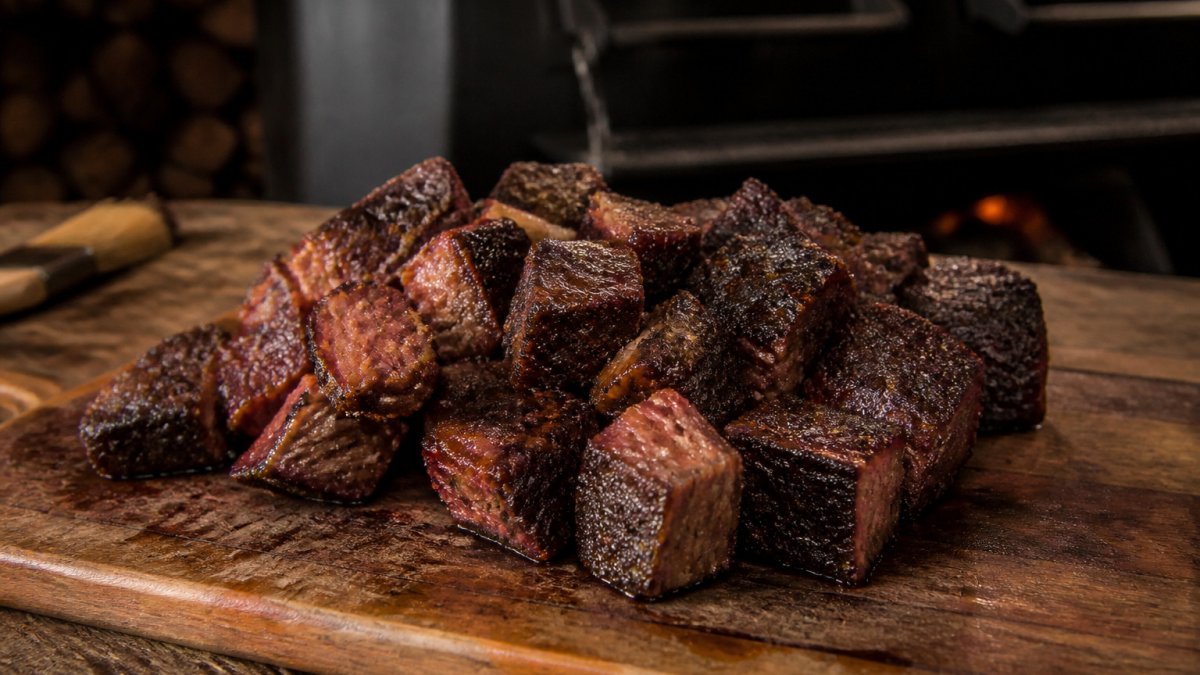
Quick Summary
The history of burnt ends begins with leftover trimmings from smoked brisket, cut from the fatty, charred point and cooked again. Kansas City helped turn them into a signature dish, and a 1972 Playboy article by Calvin Trillin is credited with popularizing them nationally. There is no single documented inventor, so the origin is best treated as a tradition built by many cooks.
- Burnt ends are cubes cut from the fatty, well-charred point of a smoked brisket.
- A 1972 Playboy article by Calvin Trillin is credited with popularizing burnt ends.
- Pitmasters began seasoning and re-cooking the ends on purpose before restaurants listed them on menus.
- Datassential reported that 44% of the population knows of burnt ends.
Table of Contents
- What Burnt Ends Are and Where the Name Came From
- Brisket Anatomy: Why the Point Became the Prize
- From Scraps to Specialty: How Pitmasters Turned Trimmings Into a Menu Item
- Who Invented Burnt Ends? The Competing Origin Claims
- Arthur Bryant's and the Kansas City Connection
- How the Dish Changed: Pork Belly, Popularity and Modern Versions
- Trying Burnt Ends at Home: A Step-by-Step Approach
- Where to Taste Kansas City's Burnt Ends on Your Next Visit
- Frequently Asked Questions
7 Milestones in the History of Burnt Ends
Last Updated: October 29, 2026
What Burnt Ends Are and Where the Name Came From
The history of burnt ends starts with a simple idea: the trimmings left over from a brisket are too good to throw away. Burnt ends are cubes cut from the fatty, well-charred point of a smoked brisket. Pitmasters season them, cook them again, and serve them as a rich, smoky bite.
The name is literal. These pieces sit near the edges of the meat, where the bark gets darkest and crispiest. Pitmasters called them "burnt" because of that deep char, and the name stuck.
Burnt ends are cubes of the charred, fatty point of smoked brisket, usually re-seasoned and cooked until tender and sticky.
Kansas City helped turn this scrap into a signature. A 1972 Playboy article by Kansas City native Calvin Trillin is credited with popularizing burnt ends, which helped the dish move from local kitchens to a national audience (Wikipedia entry on burnt ends).
Brisket Anatomy: Why the Point Became the Prize
A brisket has two main muscles. The flat is leaner and slices neatly. The point sits on top, carries more marbling and connective tissue, and stays juicier through a long cook.
That fat is exactly why the point became the prize. As the point renders over a low fire, its fat melts into the meat and leaves it soft and rich. Trimmings from the point, cut and cooked again, turned into the most sought-after bites on the cutting board.
Not every brisket has a big point, which is one reason burnt ends were always a bit of a local treasure. Pitmasters who wanted them had to prepare the whole cut with care.
From Scraps to Specialty: How Pitmasters Turned Trimmings Into a Menu Item
For a long time, the trimmed ends were just leftovers. Local accounts describe pitmasters charring brisket ends and handing them out to customers and friends. Those pieces were free or cheap, and nobody thought of them as a menu item.
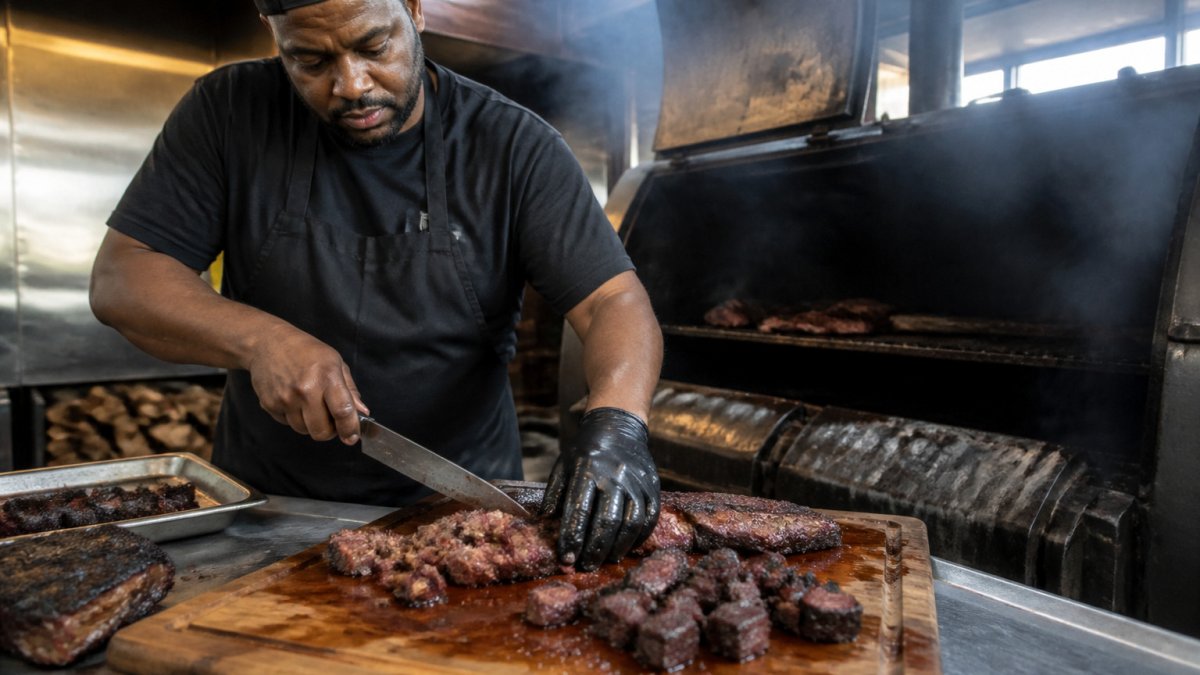
Over time, the shift happened in small steps:
- Pitmasters started seasoning the ends on purpose.
- They cooked the cubes again in sauce to make them sticky.
- Restaurants began putting them on menus as an appetizer or side.
That last step is the real turning point. Once a barbecue restaurant listed burnt ends by name, a leftover became a product people would pay for.
Who Invented Burnt Ends? The Competing Origin Claims
There is no single inventor of burnt ends, and the honest history is a timeline of claims rather than a birth certificate. What separates a credible account from barbecue lore is whether a claim can be tied to a dated source: a menu, a newspaper story, an interview, or a piece of published writing. Sorting the claims that way makes the disputed parts of the story easier to see.
The claims, in rough chronological order:
- The giveaway claim (mid-20th century). The most repeated version says a Kansas City pitmaster carved the charred, fatty ends off finished briskets and handed them to customers and friends rather than selling them. This is the version most often repeated in food writing, but it is usually told without a specific date or named source, which is why historians treat it as tradition rather than documented fact.
- The Arthur Bryant's claim. Arthur Bryant's is the restaurant most often tied to the dish, and the story usually credits it with turning the free ends into something customers asked for by name. The connection is widely reported, but the exact date the ends first appeared on a menu is not firmly established in the public record.
- The Calvin Trillin claim (1972). A 1972 Playboy article by Kansas City native Calvin Trillin is credited with popularizing burnt ends and moving the dish from local kitchens to a national audience (Wikipedia entry on burnt ends). This is the best-dated milestone in the story, and it is about popularization, not invention.
- The 'many kitchens' claim. A competing line of stories ties the dish to the broader barbecue scene that shaped the city's food culture, arguing that several joints were charring and re-cooking brisket ends around the same time. This version is harder to pin to one name, but it fits the pattern of how regional dishes usually develop.
What the sources actually support. The claims that survive scrutiny are the ones with a date or a named publication attached. The Trillin article is the clearest example. The giveaway and Arthur Bryant's stories are widely repeated but rarely anchored to a specific year, which is why they are best described as popular tradition. The 'many kitchens' version is the most defensible as history, because it does not require a single inventor.
A useful test for any origin claim you read: does it name a source and a year, or does it only name a restaurant? Claims with a date and a publication are history; claims with only a name are lore. Both belong in the story, but they should not be presented as the same kind of evidence.
Arthur Bryant's and the Kansas City Connection
Arthur Bryant's is one of the names most closely tied to burnt ends, and the connection is worth explaining rather than just repeating. The restaurant helped build the reputation of Kansas City barbecue, and many visitors still ask for the burnt ends there. The supporting story often credits the restaurant with bringing the dish into the spotlight.
Why the connection matters. Arthur Bryant's sits at the center of the city's barbecue identity, and the burnt-ends story is usually told through it because the restaurant was already famous when the dish began to spread. That timing is the key mechanism: the ends were a byproduct of the brisket the restaurant was already smoking, and the restaurant's reputation gave the byproduct an audience. A lesser-known joint could have done the same thing, but the story would not have traveled as far.
What is documented and what is not. The restaurant's role in Kansas City barbecue is well established. The specific claim that it invented burnt ends is not, and the exact date the ends first appeared on a menu is not firmly established in the public record. That gap is why the origin is best treated as a tradition built by many cooks rather than a single moment with one name attached.
How the dish moved from free to paid. The shift happened in small steps, and the restaurant story illustrates them:
- Pitmasters started seasoning the ends on purpose instead of letting them char as a byproduct.
- They cooked the cubes again in sauce to make them sticky.
- Restaurants began putting them on menus as an appetizer or side.
That last step is the real turning point. Once a barbecue restaurant listed burnt ends by name, a leftover became a product people would pay for.
Keep in mind that the connection is part of a broader story. Arthur Bryant's is a central name, but burnt ends grew out of many kitchens and many pitmasters across the city. Ordinary Times history of burnt ends documents how the origin tale was popularized while noting the competing versions.
How the Dish Changed: Pork Belly, Popularity and Modern Versions
The dish did not stay fixed. Today, you will find burnt ends made from brisket, and you will also find pork belly versions. Some modern kitchens cut pork belly into cubes, smoke them, and sauce them in the same style.
Popularity has grown too. Datassential reported that 44% of the population knows of burnt ends, with awareness highest among Millennials, Midwesterners, and high-income people (Nation's Restaurant News on Datassential findings). That spread explains why burnt ends now show up far beyond Kansas City.
The name has grown to cover more than the original brisket trimmings.
Trying Burnt Ends at Home: A Step-by-Step Approach
You do not need a full smokehouse to try the style at home. This simple approach follows the logic of the original dish:
- Start with a brisket point. Buy a point or trim the fatty end from a whole brisket.
- Smoke it low and slow. Cook until the bark is dark and the fat has rendered.
- Cube the meat. Cut the point into bite-size pieces.
- Season and re-cook. Toss the cubes in your favorite rub and sauce, then cook them again until sticky and tender.
- Rest and serve. Let them sit briefly, then serve with extra sauce on the side.
Plan on a long session, since low-and-slow smoking takes hours. Pitmasters often describe that long cook as the reason the ends turn so tender.
| Step | What to Look For | Why It Matters |
|---|---|---|
| Pick the point | Thick, fatty cut | Rich flavor and tenderness |
| Smoke low and slow | Dark bark, rendered fat | Builds smoke and texture |
| Cube and re-season | Even, bite-size pieces | Even cooking and coating |
| Re-cook in sauce | Sticky, glossy finish | Classic burnt ends texture |
Where to Taste Kansas City's Burnt Ends on Your Next Visit
If you want the real thing, visiting Kansas City is the best way to taste the history. Start with the classic barbecue spots that helped make burnt ends famous, then branch out to smaller joints for a broader view of the city's style.
Use our plan your Kansas City trip with local guides to BBQ, attractions and neighborhoods to build a route around the best burnt ends. For a deeper look at the Arthur Bryant's story and the nearby Kansas City barbecue scene, our complete guide to Arthur Bryant's menu and history covers the restaurant in detail. If you are weighing rival spots, our ranked guide to Kansas City's top BBQ joints and complete guide to Gates Bar-B-Q help you compare the options.
Frequently Asked Questions
What is so special about Kansas City BBQ?
Kansas City barbecue is known for its sweet and tangy sauces, slow-smoked meats and a wide range of cuts, including burnt ends. The city's pitmasters built a regional identity around smoking pork, beef and chicken over hardwood for long periods. Burnt ends are one of the clearest examples of that style: fatty brisket point pieces, smoked low and slow, then sauced and returned to the smoker until the edges crisp. Visitors often treat them as the signature dish to try first.
How did burnt ends get their name?
The name is usually linked to the charred, crusty edges that form on the brisket point during long smoking. Those dark, crispy pieces are the 'burnt' part, although they are meant to be bark rather than overcooked meat. Sources differ on exactly when the term took hold, and the name is widely used today for the cubed, sauced pieces of brisket point regardless of how they are cooked.
Are burnt ends the same as brisket point?
Not quite. The brisket point is the thicker, fattier muscle at the end of the whole packer brisket, and burnt ends are typically made from that point. Once the point is trimmed, cubed, seasoned, sauced and smoked again, it becomes burnt ends. So the point is the raw cut, and burnt ends are the finished dish made from it. Some pitmasters also use the deckle, the fatty area between the point and the flat.
Kansas City is the best place to see how a leftover became a legend. Plan your visit with Kansas City, where local guidance helps you find the burnt ends worth the trip.
